The call usually comes at night. Someone’s voice is tight, controlled—the kind of controlled that means they’ve been holding it together all day. “I didn’t see them until it was too late,” a driver told me once, about two hours after the police left. Or the flip side: “I had the light, but they’re saying I stepped out too soon.” Both of them were scared. Both of them were already trying to figure out what those first few words—to the officer, to the adjuster, to the other party—were going to cost them.
That fear is real. But what I’ve watched happen too many times is that fear turns into silence, or worse, into an unguarded statement that shapes the entire claim. So before you talk to anyone official, let me walk you through how fault is actually determined—not how it feels in a comment thread, but how it gets evaluated when the paperwork starts.
What the Claims Process Is Actually Measuring
Most people imagine fault as a verdict: someone was wrong, someone was right.
The legal process is more like a scale. It’s asking, how much did each party’s choices contribute to what happened? The foundation of any pedestrian accident claim is negligence. Proving negligence requires showing four things:
- Someone had a duty of care
- They breached that duty
- The breach caused the accident
- Real damages resulted
Every driver on a public road owes a duty of care to every pedestrian—that’s not optional, it’s baked into traffic law. Every pedestrian, in turn, has a responsibility to act reasonably in traffic. Duty of care runs both directions.
What adjusters and attorneys are actually doing when they review a claim is asking where that duty was breached. Did the driver fail to yield at a marked crosswalk? Was the pedestrian wearing dark clothing at night and crossing mid-block against traffic? Both can be true at once. That’s where the scale metaphor matters.
If you’re a boston pedestrian accident lawyer or someone who’s worked municipal claims like I have, you learn quickly that the narrative people carry out of the accident scene—”I had the right of way,” “they came out of nowhere”—is only the starting point. What the evidence shows is what controls.
Right of way is important, but it’s not a shield. A pedestrian in a crosswalk with the signal has the right of way, yes. But if a driver had a green light and a pedestrian stepped off the curb without looking, both facts go into the analysis. Right of way establishes who had legal priority—it doesn’t automatically assign 100% fault to whoever violated it.
Comparative vs. Contributory Negligence: A Side-by-Side Look
This is the part most people don’t know, and it changes everything about how much a mistake actually costs you.
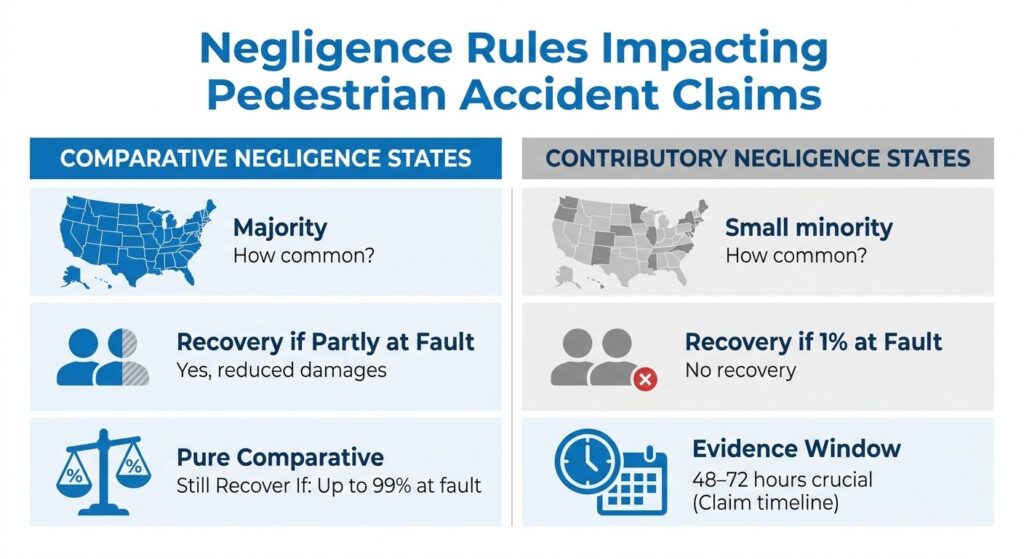
| Feature | Comparative Negligence | Contributory Negligence |
|---|---|---|
| How common? | Majority of U.S. states | Small minority of states |
| Can you recover if partly at fault? | Yes, with reduced damages | Generally no—even 1% fault may bar recovery |
| Variations | Pure (any % recovers) vs. Modified (50/51% threshold) | No standard variations |
| Impact of jaywalking | Raises your fault percentage; doesn’t end the claim | Can eliminate recovery entirely |
| Stakes for evidence | High | Extremely high |
Under pure comparative negligence, even a pedestrian found 90% at fault can recover 10% of their damages. Under modified comparative negligence, recovery is cut off if your share of fault crosses a threshold—usually 50% or 51%. Under contributory negligence, the harsh outlier, contributing even 1% to the accident may bar you from recovering anything.
That’s not fair in every case. I’ve seen people lose recovery over genuinely minor decisions. But it’s the reality, and knowing it changes how you approach the evidence.
What does this mean practically? In a comparative negligence state, a pedestrian who crossed mid-block isn’t automatically out of luck. The driver still had a duty to exercise reasonable care—to be watching, to be driving at a speed that allowed reaction time. If the driver was speeding, distracted, or failed to brake when they had time to, that conduct gets weighed against the pedestrian’s crossing choice. The percentages get negotiated, sometimes litigated.
In a contributory negligence state, a single piece of footage showing the pedestrian had a clear opportunity to see the vehicle can close a claim entirely.
If you’re unsure which rule applies where you live, that’s the first question worth asking an attorney—because it frames everything else.
The Evidence Timeline: What Gets Collected and When It Matters
Here’s what most people don’t realize: the evidence window closes fast.
Surveillance footage gets overwritten. Skid marks fade. Witnesses scatter. The first 48 to 72 hours after an accident are the most important for building or defending a claim.
Fault determination evidence in pedestrian claims typically falls into four categories, each doing different work:
The police report is usually the first document an adjuster reads. It contains the officer’s observations, any citations issued, and sometimes a narrative about what the officer believes happened. People treat this as the final word. It isn’t. Federal crash-reporting guidance from NHTSA is clear that narrative fields in police reports are not conclusive fault findings—a report that says a pedestrian was “at fault” can still be challenged with independent evidence like video footage, event data recorder downloads from the vehicle, or witness accounts that contradict the officer’s narrative. I’ve seen police reports overturned in claims more times than I can count.
Witness statements are gold when gathered quickly. A bystander who saw the driver on their phone, or who watched the pedestrian step out from between parked cars—that testimony shapes the percentage allocation significantly. If there were people nearby when the accident happened, getting their contact information before they leave the scene is one of the most valuable things you can do.
Photographs and video from traffic cameras, nearby businesses, or dashcams can confirm or contradict everything else. Request preservation of that footage in writing immediately—retention periods are short, and once it’s gone, it’s gone.
Medical records matter for two reasons: they document the damages (one of the four negligence elements), and they establish a timeline. If a pedestrian waited three days to see a doctor, an adjuster will argue the injuries weren’t serious or weren’t caused by the accident. That argument isn’t always fair, but it’s common. Getting evaluated promptly protects you.
The Questions People Are Afraid to Ask
What if I was jaywalking?
It complicates things, but it doesn’t end the claim in most states. Jaywalking may raise your percentage of fault under comparative negligence. But if the driver was speeding, distracted, or had time to brake and didn’t, their negligence still exists. The question is how the percentages fall.
What if the driver had a green light?
A green light means the driver had the right of way at that moment. It doesn’t mean they had no duty of care toward a pedestrian who was visible in the roadway. Drivers are expected to exercise reasonable care even when they have the legal right to proceed.
What if I didn’t call 911 right away?
A delayed report can raise questions, but it doesn’t destroy a claim. Document everything you can as soon as you’re able—photos of the scene, your injuries, the vehicle, the location. That documentation becomes your independent evidence.
What about the citation?
Insurance adjusters often anchor hard on whether a citation was issued and to whom. But as consumer claim guidance from the FTC notes, a citation is not a liability determination on its own. If an adjuster is using a citation as the sole basis for denying or reducing a claim, you have the right to ask for their comparative-fault percentage, the specific evidence they relied on, and any reconstruction analysis behind that number. You’re allowed to push back.
What if I said something at the scene that sounded like an apology?
“I’m so sorry” said in shock is not a legal admission of fault. It can be used in a claim, but context matters, and a good attorney can address it. What you want to avoid going forward is making detailed factual statements to the other party’s insurance company without understanding how they’ll be used.
A Practical Checklist for Right Now
If the accident just happened—or happened recently and you haven’t taken formal steps yet—here’s where to focus:
- [ ] Get the police report number and request a copy as soon as it’s available
- [ ] Review the report for accuracy; note any narrative errors specifically
- [ ] Gather photos or video you took at the scene
- [ ] Identify nearby businesses or traffic cameras and request footage preservation in writing
- [ ] Write down your own account while it’s fresh: time, weather, lighting, sequence of events
- [ ] Do not share your written account with the other party’s insurer
- [ ] Get a medical evaluation promptly, even if injuries seem minor
- [ ] Keep a running record of every medical visit, expense, and missed workday
These details build the damages portion of your claim, and they’re easy to lose track of when you’re recovering.
Where to Go From Here
Most pedestrian accident cases come down to a specific set of local rules, local evidence, and local insurance practices.
Knowing those rules—comparative versus contributory negligence, what your state’s right-of-way statutes actually say, how adjusters in your area typically weight a police report—is the difference between accepting a lowball offer and understanding what your claim is actually worth.
You don’t have to have everything figured out before you ask for help. A confidential consultation with an attorney who handles pedestrian claims costs you nothing but an hour, and it can tell you exactly where you stand before you say another word to an insurance company.
That’s not a dramatic step. It’s just information—and right now, information is the thing you need most.